
I Weighed Every Gram of Food I Ate. Here's Why I Stopped.
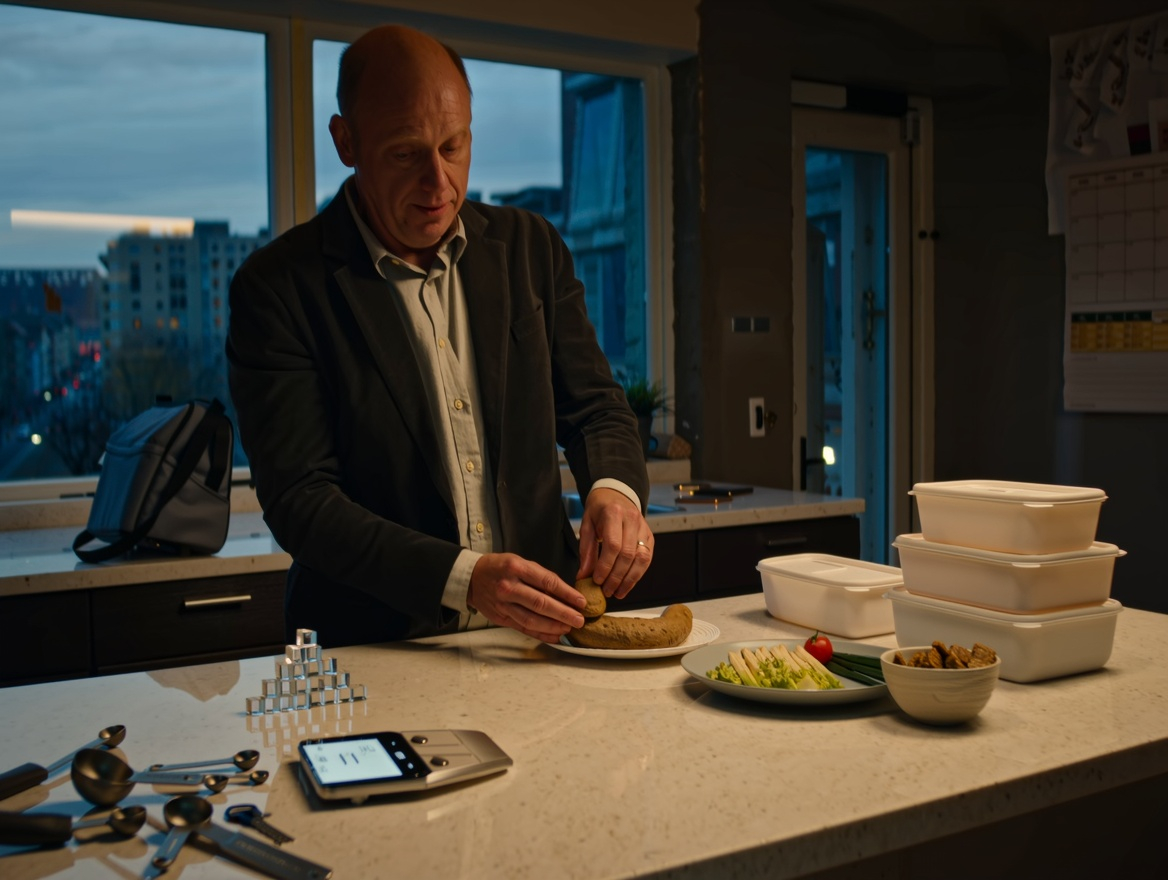
Every meal was a math problem.
I'd wake up already calculating. How many calories do I have today? What do I "afford" for breakfast? What happens if I eat this now versus later?
Someone invites me out? Panic.
Meeting runs long and dinner shifts? My whole plan falls apart.
I couldn't measure something cleanly, so I felt anxious. I thought this was discipline. I thought this was what staying consistent looked like.
Then one day, I noticed something.
The moment tracking got disrupted, my confidence collapsed.
Travel. A social meal. Eating at someone else's house.
Anything that made the numbers fuzzy sent me spiraling. I'd either overcorrect, under-eat, or throw my hands up and say "screw this" because I couldn't be precise.
That's when things clicked.
If the only way I eat well is by measuring every gram, then I don't know how to eat well.
I know how to track.
And tracking isn't a skill.
It's dependence.
Then I Started Seeing the Same Pattern Everywhere
Once I started coaching, I watched this play out over and over.
Smart people. Capable people.
Senior professionals. Executives. People who manage teams and million-dollar deadlines.
They'd come to me after years of restart cycles. They'd tried everything. Tracking apps. Macro counting. Meal plans. They knew what "healthy" looked like.
So why couldn't they stay consistent?
The pattern was always identical.
They'd do great for a week or two. Then life would get volatile. A late meeting. A travel day. A kid issue.
The whole system would collapse.
Not because they didn't care.
Because the plan only worked when life was controlled.
And here's the thing about high-pressure people: controlled weeks are rare.
The Hidden Cost of Tracking Everything
Here's what most people miss about calorie counting and macro tracking.
You're outsourcing your decision-making to an app.
You're not learning how to feed yourself well. You're learning how to follow instructions.
And the data backs this up.
78% of calorie tracking app users quit within three months. They spend an average of 72 minutes daily on food logging and related behaviors. 63% describe this as "mentally exhausting."
That's not a motivation problem.
That's a design problem.
Here's why: cognitive load.
Daily tracking activates brain regions at levels associated with 17% reduced performance on working memory tasks.
What does this mean for you?
Tracking depletes the mental resources you need to make good decisions about everything else in your life.
When stress is high and time is low, this depletion shows up as decision fatigue.
Meals get delayed. Hunger gets extreme. The day turns into reactive eating, takeout, and late-night grazing.
Then you blame yourself for lacking discipline.
But the problem isn't discipline. You're trying to out-think exhaustion.
So What Do I Do Instead?
I don't give clients meal plans anymore.
I don't teach macro counting.
I don't hand them a tracking app.
Instead, I build what I call nutrition infrastructure.
What's infrastructure?
Systems that work when you're tired, stressed, and behind. Defaults, not decisions. Your environment does the heavy lifting, not your willpower.
Here's what this looks like:
Two protected meals. Not a full week of planned meals. Two meals the client hits four to six days a week with low thought and low prep. We build a normal version and a chaotic-day version so this survives meetings, travel, and low energy.
Defaults by environment. A short list of go-to options for the places they eat: home, office, restaurant, travel. The point? Pre-decisions. When it's 2:15 and they haven't eaten, they're not "figuring things out." They're choosing from a list they already trust.
A backup ladder. A tiered fallback system: best case (cook), next best (simple assembly), next best (order the default), last resort (convenience store option). The ladder removes the all-or-nothing trap because there's always a next step.
One chaos rule. When the day falls apart, you return to the next protected meal. No compensation. No restart tomorrow. No trying to "make up for things."
That's it.
No tracking. No math. No logging every bite.
The Law Firm Partner Who Hit 8 Weeks
Let me tell you about a client.
Law firm partner. Constant meetings. Hadn't eaten consistently well in three years.
Everything she'd tried before was optimized for ideal weeks.
Tracking. Tight rules. Complicated cooking. "Start Monday" intensity.
Those plans relied on time, energy, and attention being stable.
Her life wasn't stable.
So every disruption wasn't a small deviation. It was a system failure. The guilt from this failure pushed her into the restart loop.
When we started working together, I didn't give her a meal plan.
I didn't ask her to track.
We built two protected meals and one protected decision each day, with a version for when the day got hijacked.
Here's what we set up:
Most days she hit a simple breakfast without requiring thought. Lunch wasn't "clean eating." It was a default order she could repeat without debate. The third piece was a bridge snack before her predictable crash window so she didn't walk into late afternoon depleted and reactive.
Dinner was allowed to be flexible, with one rule: anchor protein first, then add whatever made things realistic.
If she did those three things, the day counted.
Now here's where things got interesting.
Her breakthrough wasn't a weigh-in.
It was the first time a "bad day" didn't turn into a "bad week."
She had a week where meetings ran long, lunch got blown up, and there was an unexpected dinner she couldn't control. In the old pattern, that's where she would've said "I'm off," felt behind, and mentally scheduled a restart for Monday.
This time?
She used the system. She hit the bridge snack instead of pushing through. Made a simple protein-first choice at dinner. The next morning she went straight back to her protected breakfast without trying to compensate.
In our check-in she said, "I didn't spiral."
You could hear the surprise in there.
She stopped seeing disruption as proof she couldn't do this. She started seeing disruption as something the system handles.
She hit eight weeks.
Not because she suddenly became more disciplined.
Because the system respected the reality of her environment.
Why Architecture Beats Arithmetic
Here's something worth knowing.
The average person makes over 200 food-related decisions daily. This contributes to decision fatigue where quality deteriorates as mental resources get depleted.
Now add tracking arithmetic on top of this.
Logging. Weighing. Calculating.
You're not building autonomy. You're adding friction.
And here's the part most people don't realize: food consumption decisions are shaped by environmental cues that range from the room, the furniture, and the container to the food itself.
What does this mean for you?
Your environment determines your choices more than your knowledge does.
So the question isn't "how do I get better at tracking."
The question is "how do I design my environment so the default choice is the right choice."
That's architecture.
And architecture beats arithmetic every time when eating well without dieting.
The Real Goal Isn't Tracking Forever
Look, I'm not against tracking as a short-term diagnostic tool.
If you want to see what you're eating for two weeks, fine. This is useful data.
But tracking as a permanent strategy creates a problem.
You never learn to operate without this.
So what's the goal?
The goal isn't to count calories forever.
The goal is to build a system for feeding yourself well when life is messy, when you're tired, when you don't have time to log, and when the app doesn't have the restaurant you're at.
The goal is autonomy.
And autonomy comes from infrastructure, not arithmetic.
Your Starting Point: Three Simple Steps
If you're reading this and thinking "okay, but what do I do," here's where to start.
Week one. Three steps.
Pick one meal to protect. Not your whole day. One meal you hit four to six days a week with low friction. Define what makes this count (a solid protein anchor, some plants or fruit, a satisfying carb or fat). Build a normal version and a messy version for when life is chaotic.
Set one chaos rule. When the day falls apart, return to the next protected meal. No compensation. No restart tomorrow. The day might be messy, but you always have a next best step.
Remove one decision. Pick one environment where you eat regularly (home, office, restaurant) and create a default. A go-to order. A repeatable option. Something you don't have to think about.
That's it for week one.
You're not tracking.
You're not logging.
You're not doing math.
You're building infrastructure.
What I Know Now
I used to believe precision was the path to consistency.
Now I know simplicity is.
I used to think my job was to educate people about nutrition. Teach macros. Explain energy balance. Give them more tools.
Now I know my job is to remove the need for constant nutrition knowledge.
Because here's the thing.
The less you think about food, the better you eat.
Not because you're ignoring food.
Because you've built a system carrying the load so you don't have to.
That's the difference between dependency and autonomy.
And autonomy is what makes nutrition sustainable.