The Gym Selfie Economy: Why Real Health Looks Boring
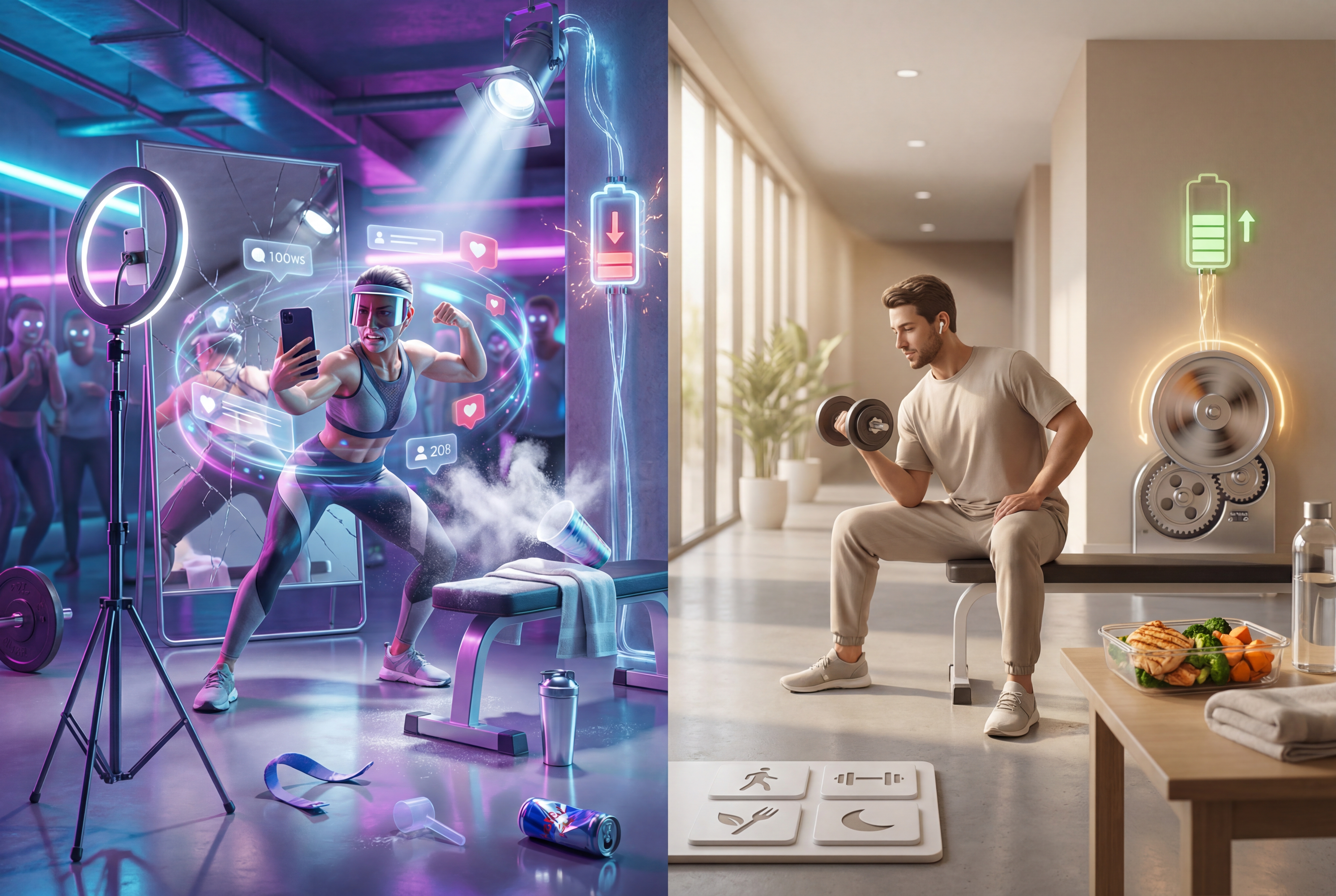
The gym selfie industrial complex has convinced us fitness is a performance. Something to document. Something to prove.
But real health looks boring.
It's the same walk every morning. The same protein at lunch. The same 20-minute strength session in a hotel gym while you're traveling.
Nobody films maintenance.
That's why it works.
The Performance Trap Has Data Behind It
People who saw lots of fitness posts were more likely to be overly concerned about their weight, according to research published in Health Communication.
The reason is simple: idealized body images on social media are hard to achieve. When you're exposed to transformation posts and progress photos, this creates a detrimental effect on body esteem.
The performance obscures the maintenance.
A systematic review found fitspiration content claims to inspire people to achieve fitness and health, but it's more closely related to motivations focused on appearance. The content is generally of poorer quality and produces more detrimental consequences for psychological health and behaviors.
The documented version often undermines the actual practice.
What Actually Drives Results
Research published in the European Journal of Social Psychology found people need roughly 66 days to form a habit. Not one dramatic "all-in" session with 10,000 likes.
High-step users show 36% lower variability in their activity patterns compared to 55% in others. Steady, repeatable habits are the key to logging the most exercise over weeks and months.
Studies on distance running suggest the optimal balance is 80% low intensity and 20% high intensity. The gym selfie culture glorifies the opposite.
The same walk every morning works because your body thrives on predictable patterns. Not because photos look good.
Temporal Consistency Beats Intensity
Most successful weight loss maintainers reported temporally consistent exercise. These people reported higher frequency and duration of physical activity.
Temporal consistency was associated with greater physical activity regardless of the specific time of day.
Translation: doing the same thing at roughly the same time matters more than doing impressive things sporadically.
The Business Model That Profits From Your Failure
The fitness industry doesn't want you to succeed permanently. This is incentive math.
Most of the industry makes money on repeat acquisition. Not long-term resolution.
Products are sold as events: 30-day challenges, 6-week shreds, detoxes, "new year" resets. These are designed like a launch with big promises, short timelines, and high urgency.
When results fade or life hits, you need the next event.
This isn't an accident. It's the revenue engine.
Weight Regain Creates Repeat Customers
More than half of lost weight is regained within 2 years. By 5 years, more than 80% is regained.
That reality means the market for "start over" never dries up.
When people interpret the rebound as personal failure, they don't demand a better system. They buy another fix.
The supplement market thrives on this cycle. Monthly "stacks," sleep aids, stress blends, fat burners. The customer doesn't need one purchase. They need hope on subscription.
Why Simplicity Is a Competitive Disadvantage
Simple works quietly. You don't get dramatic before/after photos in 14 days.
Sustainable progress is boring by design: fewer rules, fewer moving parts, fewer "new programs."
If your business runs on newness, then a coach teaching "repeatable defaults and worst-week coverage" is selling people out of your funnel.
For most coaches, sustainability is economically inconvenient. This reduces the demand for resets. This reduces dependency on the coach as the "new plan dispenser."
The irony: this is a disadvantage inside the traditional industry model, but a massive advantage if your business model is built on retention, referrals, and long-term outcomes.
What Institutions Are Starting to Notice
A popular gym chain in Melbourne complained of influencers engaging in "entitled and selfish behavior." Much of this stemmed from patrons concentrating more on generating social media content than their performance in the gym.
Banning selfies could make influencers rethink their behaviors, tone down self-promotion, and bring back a sense of camaraderie among gym-goers.
This might be the beginning of people exercising for themselves and nobody else.
The institutions are catching up to what sustainable fitness has always known.
The Engagement Pattern That Predicts Dropout
A study found users whose primary engagement was instructional (form tutorials, workout plans) showed increased autonomous motivation.
Those whose primary engagement was comparative (scrolling transformation posts, measuring progress against influencers) showed significantly higher levels of appearance anxiety, exercise dependence, and dropout after six months.
People don't film maintenance because maintenance builds capability, not content.
Consistency Outperforms Extreme Approaches
People who exercised consistently had a 26% lower chance of becoming depressed. The intensity didn't matter, according to JAMA Psychiatry.
People who consistently exercised 3-5 times per week saw significantly better heart health outcomes than those who trained intensely but irregularly, per the British Journal of Sports Medicine.
The same protein at lunch beats the viral transformation post every time.
What Real Health Actually Looks Like
Real health is a client who travels three times a month hitting 9 out of 10 planned sessions. Not perfect workouts. Sessions with consistent touches.
Walking in airports. Lifting in a cramped hotel gym. Doing 20-minute sessions in weird windows.
This isn't pretty. But it's steady.
Real health is the partner at a law firm who hadn't exercised consistently in 3 years hitting 8 weeks straight with 20-minute sessions, no decisions, and a backup plan.
Real health is eating pizza at 11pm, not tracking, not feeling guilty, waking up and moving on.
Because consistency isn't built by perfect days. You build consistency by clean recoveries.
The Floor Plan That Survives Chaos
The plan that works has three characteristics:
Calendar-first, not motivation-first. Specific windows instead of "whenever." Booked like a meeting.
Remove the exercise menu. Two workouts on repeat in A/B style. Same warm-up. Same first two lifts. Same flow. The friction isn't the workout. The friction is the decisions.
Built-in if-then rules before the week starts. Miss Tuesday, do Wednesday morning. Travel week, hotel version only. Long day or low sleep, minimum session only.
You never have to ask what to do now. You execute the default.
The Body Ledger Nobody Talks About
Every skipped meal, every 4-hour sleep night, every workout traded for a deadline is debt.
Sleep debt raises your daily operating cost. More caffeine to feel normal. More irritability. Worse decision-making late in the day. Recovery slows down.
Meal skips create energy volatility. You get a mid-day crash. You get late-day cravings. You get reactive eating at night.
Trading workouts for deadlines means loss of structural resilience. When strength work disappears for weeks, you don't pause progress. You lose capacity.
When you return, everything feels harder. Soreness spikes. Little aches show up.
People interpret this as "I'm getting old" instead of "I'm detrained."
What Interest Looks Like
Interest is when the debt starts charging you in other currencies:
Time. Everything takes longer.
Mood. Lower patience. More snapping.
Appetite. Cravings louder. Satiety weaker.
Pain. Aches, tightness, tweaks.
Motivation. The idea of doing anything feels heavy.
High performers feel blindsided. They think they're borrowing from "health" to pay "work."
But the payback comes as reduced performance everywhere.
The Early Warning Signs Your System Is Breaking
You're tired even after sleep. Not acute tired. Persistent fatigue.
Your workouts feel heavier at the same loads. Warm-ups feel like work. Recovery feels slow.
You're getting more snacky and less satisfied. Cravings up. Grazing up. Especially late in the day.
You're more reactive. Small stressors feel big. Less patience with people you care about.
You're relying on stimulants and numbing. More caffeine earlier. More screens or alcohol at night.
You start saying "I need to get through this month."
This sentence is the ledger talking. It's always longer than a month.
What Changes When You Stop Performing
I had a client who used to dread our check-ins. She felt like she was coming to report her failures.
This sentence changed how I coach.
Because I realized I'd accidentally trained this behavior. I thought my job was to push people, hold them accountable, turn up the heat.
But when I tried to manufacture motivation, I was manufacturing shame.
Shame doesn't create consistency. Shame creates hiding. Shame creates avoidance. Shame creates the all-or-nothing spiral.
Now my job isn't to hype you up.
My job is to make the plan so practical and so resilient you don't need hype to execute.
The Three-Variable Audit
Before touching a single workout, I run a three-variable audit with every client:
Sleep hours. Last real meal. Stress level 1-10.
These three tell me, in 60 seconds, whether a workout plan is going to land or become another "good plan gone by Wednesday."
If sleep is low, meals are chaotic, and stress is high, a full training plan is often the wrong first lever.
Not because training is bad. Because training becomes one more thing they "fail," which reinforces the spiral.
The Shift From Perfection to Unbreakability
There was a version of me who would've spiraled from pizza at 11pm.
"You blew this." "Might as well finish the night." "Start over Monday."
Then I'd try to punish this with extra cardio or a tight food day the next day.
Not because I didn't know better. Because my identity was built on being "disciplined."
A slip didn't feel like a choice. A slip felt like a character flaw.
The internal shift was realizing: consistency isn't built by perfect days. You build consistency by clean recoveries.
I stopped measuring myself by whether I had a mistake and started measuring myself by how fast I returned to baseline.
I separated data from drama. Pizza is information. Pizza tells you what happened in your day (stress, hunger, social life, schedule).
This is not a moral event.
I stopped over-correcting. Over-correction creates the spiral.
If you respond to pizza with punishment, you teach your brain imperfection is dangerous. The next time this happens, you panic.
If you respond with a normal breakfast, a walk, water, and your usual plan, your nervous system learns: nothing is wrong. We're fine.
This is what "continuing without drama" looks like. A trained response.
What Survives When the Camera Turns Off
The gym selfie economy will keep selling you the performance version of fitness.
Dramatic transformations. Intense workouts. Perfect meal prep. Morning routines needing an hour and ideal conditions.
None of this survives chaos.
What survives is the boring stuff:
The same walk every morning.
The same protein at lunch.
The 20-minute strength session counting even when it's not your best.
The if-then rule running when willpower is gone.
The ability to have an imperfect day and continue without drama.
This is not content. This is capability.
And capability is what you have left when the motivation fades and the camera turns off.
Real health looks boring because boring is what you repeat when life does what life does.
People don't film maintenance.
That's why maintenance works.