Why I Refuse to Give Clients Meal Plans (And What I Do Instead)
I stopped giving meal plans three years ago. Not because they don't work in the short term. They do. For about two weeks. Sometimes three if life stays perfectly stable.
Here's what I kept watching happen: someone would follow the plan beautifully. Check every box. Hit every meal. Feel proud. Then a normal week would arrive—late meetings, travel, a kid's schedule shift, an unexpected dinner—and the plan would offer exactly one option: fall off.
The part that made me draw a hard line wasn't the deviation. What happened after.
The Apology That Changed Everything
Someone came to a check-in apologizing like she'd committed a moral failure.
"I didn't follow the plan. I'm sorry. I need you to give me something stricter. I don't do this."
She was a senior professional. Managed teams. Made high-stakes decisions daily. She'd internalized eating a sandwich instead of the prescribed meal meant she'd failed.
The conversation landed hard because the truth was obvious: she didn't fail. The plan failed.
The plan had no translation for reality. Only worked when the week was controlled. The moment life got unpredictable, the system offered her one path: abandon ship. Once she fell off, shame kicked in and she reached for tighter rules. The next disruption would be even more explosive.
I decided I'm not handing people a script they follow only in perfect conditions.
What Meal Plans Actually Teach
A meal plan creates short-term compliance. Teaches the wrong skill.
Teaches "follow this when life is calm," not "feed yourself well when life is messy." For the people I work with—high performers operating under sustained cognitive load—messy is the default.
Here's what I kept seeing: meal plans quietly outsource autonomy. People would do great while the plan was fresh. Then the first disruption hit and the plan didn't translate. They'd either abandon the plan completely or treat any deviation as failure.
The restart loop wasn't unhelpful. Damaging. Reinforced the belief they succeed when someone hands them rules.
Research backs this up. Studies show low adherence is associated with inflexible dietary plans. Plans don't account for people's preferences and whether they have negative views of restrictive eating plans.
The problem isn't the person. It's the design.
The Real Pattern I See
When I look at people who are successful in their careers but struggling with eating consistently well, I rarely see a knowledge problem.
These are people who value structure and routine. They execute at a high level in their work. Their nutrition system is designed for stable weeks. Stable weeks almost never happen.
When work, family, or travel creates volatility, the plan has no survivable mode. They default to whatever is easiest in the moment. Then they interpret this as a personal flaw instead of a design issue.
The deeper pattern is an execution mismatch. At work, their environment forces the behavior: meetings are scheduled, deliverables have deadlines, other people are waiting. With eating, the system is based on intention and willpower.
When stress is high and time is low, decision fatigue spikes. Meals get delayed. Hunger gets extreme. The day turns into reactive eating, takeout, late-night grazing.
You'll hear "I got busy," but what's happening is the environment wins because there aren't defaults, boundaries, or pre-decisions in place.
What I Build Instead: Infrastructure, Not Instructions
I don't give meal plans anymore. I build decision systems and infrastructure.
Here's what this looks like in practice.
Two Protected Meals
We pick two meals you hit 4-6 days a week with low thought and low prep. Not optimal meals. Repeatable meals.
A protected meal has three things: happens most days, low friction, and a minimum standard. The standard is simple. A solid protein anchor, some plants or fruit, and a satisfying carb or fat. Keeps things realistic.
Then we build a messy version of the same meal for when life is chaotic. A restaurant order. An airport option. A convenience store backup. An office default.
The goal isn't perfection. It's stability.
Defaults By Environment
We create a short list of go-to options for the places they eat: home, office, restaurant, travel.
The point is pre-decisions. When it's 2:15pm and they haven't eaten, they shouldn't be figuring things out. They're choosing from a list they trust.
This matters because research shows we face more than 200 decisions about food daily. The overwhelming array of options creates a paradox. More choice leads to poorer decision-making and increased stress.
A Backup Ladder
A tiered fallback system removes the all-or-nothing trap.
Best case: cook the planned meal.
Next best: simple assembly.
Next best: order the default.
Last resort: convenience store or airport option.
There's a next step. Counts.
One Chaos Rule
When the day falls apart, you don't restart tomorrow. You return to the next protected meal right away.
No punishment. No compensation. No "I'll be good Monday."
The day might be messy, but you have a next best step. Keeps the system alive.
The Case That Proved It
Law firm partner who hadn't eaten consistently well in three years. High performer. Managed complex cases. Her nutrition operated on a restart cycle.
We didn't start with a meal plan. We built infrastructure.
Two protected meals. Didn't require thought. A short list of defaults for her environments. A minimum standard. Still counted on chaos days. One rule for breakdown weeks: return to the next protected meal right away.
She hit eight weeks of consistency. Not because she suddenly became more disciplined. Because the system respected the reality of her environment.
Her breakthrough wasn't a weigh-in. The first time a bad day didn't turn into a bad week.
She had meetings run long, lunch got blown up, an unexpected dinner she couldn't control. In the old pattern, she would've said "I'm off" and mentally scheduled a restart for Monday.
This time, she used the system. Hit the bridge snack instead of pushing through. Made a simple protein-first choice at dinner. The next morning she went straight back to her protected breakfast. No compensation.
In our check-in she said, "I didn't spiral."
You heard the surprise in her voice.
The shift. She stopped seeing disruption as proof she couldn't do this. She started seeing disruption as something the system is built to handle.
Why This Matters
The statistics on traditional dieting approaches are brutal.
95% of dieters regain the weight they lost within two years. When diets fail, not because of lack of willpower. Our bodies interpret calorie restriction as a threat to survival and respond with metabolic, hormonal, and neurological changes. These overwhelm willpower.
Research shows roughly 80% of people who shed a significant portion of their body fat will not maintain weight loss for 12 months. Dieters regain, on average, more than half of what they lose within two years.
The problem isn't the people. It's the approach.
Studies on intuitive eating show a different pattern. Greater baseline intuitive eating and increases in intuitive eating were both associated with lower odds of high depressive symptoms, low self-esteem, high body dissatisfaction, unhealthy weight control behaviors, and binge eating at 8-year follow-up.
The difference? One approach builds dependency. The other builds capability.
Protection vs. Planning: The Core Difference
Someone will ask: isn't this meal planning with a different name?
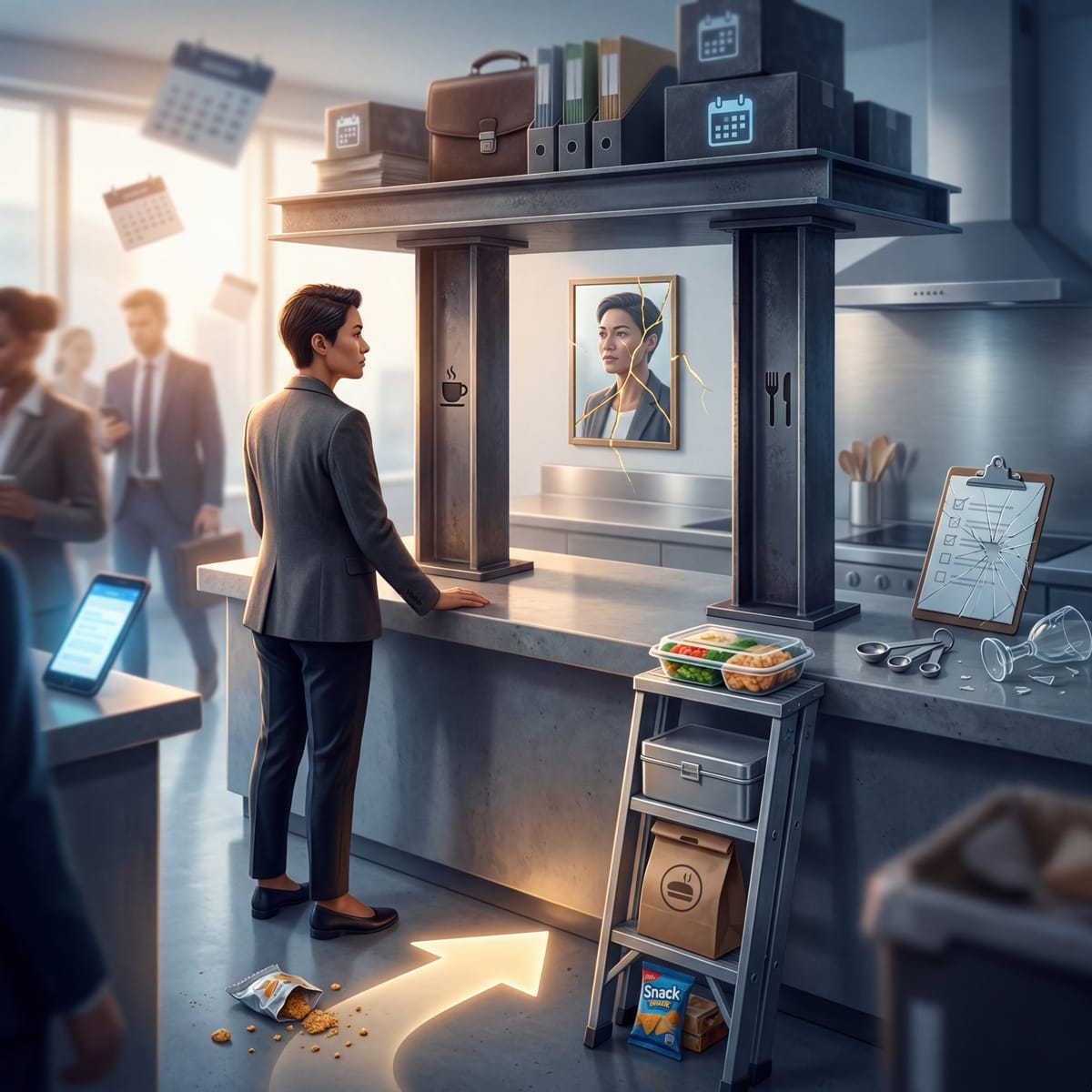
No. Meal planning is a menu. Protected meals are an operating system.
Traditional meal planning tries to predict the week and prescribe what you'll eat. Assumes time, energy, and schedule stability. Wins by compliance. When life changes, the plan breaks, and people feel like they failed.
Protection is built for volatility. We're not planning a week of meals. We're installing two anchors that hold up under load, plus the decision rules and backups that keep the day from collapsing when the plan doesn't work.
Here's the sharp distinction: meal planning answers "what will you eat?" Protected meals answer "what will you do when you don't eat what you planned?"
Protection includes a minimum standard that still counts, a messy version for real life, and a fallback ladder so there's a next-best move. Designed to reduce thinking, not add structure you have to maintain.
The goal isn't variety or perfection. It's stability and autonomy.
Meal planning is content. Protected meals are resilience. One is a schedule. The other is infrastructure.
What This Actually Looks Like
When I start with a new person, the first two weeks look nothing like traditional nutrition coaching.
Week one is about mapping reality. Finding the true breakpoints.
I get a day-in-the-life walkthrough. Not general habits. Actual timing. When do you wake up, when's your first caffeine, what time do you first eat, when do meetings stack, when do you get home, when do you snack, when do you go to bed.
I'm listening for predictable crash windows: late lunch, 3pm brain fog, late-night grazing. I'm also watching language. Where shame shows up, where perfectionism shows up, where they've been restarting.
Then I ask what they've tried and why things broke. Reveals whether the issue is volatility, decision fatigue, environment, or all-or-nothing thinking.
The first move is deliberately small. We pick one protected meal to install right away. The goal is early proof. We choose the meal with the highest leverage and the lowest friction.
We define the minimum standard. What makes things count. We build two versions: normal and chaotic.
During the week I'm watching for two things: execution friction and emotional friction.
Execution friction is "I didn't have food available" or "meetings ran through lunch." Emotional friction is "I felt guilty" or "I felt like things didn't count."
Those two frictions tell me what to change: access, timing, or rules.
Week two is where we stabilize. Add the second beam.
We review what happened in plain terms: what worked, what broke, and what the pattern was when things broke. Then we adjust the protected meal to be even easier. Less prep, fewer ingredients, more portable, a clearer default order.
If the meal didn't happen, I assume the design is wrong. Not the person.
Then we install the second protected meal. Same process. This is also when I introduce the single chaos rule: when the day falls apart, you return to the next protected meal right away. No compensation. No restart tomorrow.
By the end of two weeks, I'm not looking for perfect adherence. I'm looking for reliability: fewer long gaps, fewer emergency decisions, quicker recovery after misses.
If those are improving, fat loss becomes a byproduct. Not a battle.
The Principle Behind Everything
I operate from one core principle: the less you think about food, the better you eat.
Counterintuitive to most nutrition advice. What I've watched predict success over 8-12 weeks.
Early on, I thought my value was education. Teach macros. Explain energy balance. Give people more tools. Worked in the short term. People felt motivated and informed.
Then the same thing kept happening: the more information they had, the more they tried to engineer perfect days. Perfect days don't exist for the people I work with.
The pattern changed my approach: high performers weren't failing because they didn't understand nutrition. They were failing because they were overloaded.
Under stress, more options and more rules didn't create better choices. Created more decisions. More decisions meant more friction. Friction meant inconsistency.
When we replaced "know more" with "decide less," everything improved. Fewer skipped meals. Fewer reactive afternoons. Fewer nighttime cleanups.
The biggest win wasn't weight loss. Calm. They stopped negotiating with food all day.
My job shifted from educator to designer. I still teach what matters, only in service of reducing thinking: build two protected meals, a handful of go-to options, simple rules for chaos.
When the system carries the load, they don't need constant nutrition knowledge to eat well.
What This Really Means
I remember someone looking at me on a check-in and saying, "I don't trust myself."
Not "I don't know what to eat." Not "I need more motivation." She meant the way you mean when you've let yourself down so many times. You stop believing you follow through on anything for you.
We were talking about food, but what she was describing was the slow erosion of self-respect. Happens after three years of restart cycles. Every Monday reset was another little vote for "I'm the kind of person who doesn't keep promises to myself."
You felt the grief under the words. Not dramatic. Heavy. Like she'd been carrying this around for a long time.
The moment that changed everything was a week where life hit her hard and she still didn't spiral. She didn't make up for things. She didn't punish herself. She returned to the next protected meal and kept moving.
On the next call she said, quietly, "I'm proud of how I handled things."
When the work stopped being about food for me.
What we were rebuilding wasn't a diet. Trust.
Once someone gets trust back, the nutrition part becomes secondary.
The Line in the Sand
I refuse to give meal plans because they solve the wrong problem.
They optimize for compliance in controlled conditions. The people I work with don't have controlled conditions. They have volatile schedules, high cognitive load, compressed time, and environments that don't support the behaviors they're trying to build.
A meal plan in this context isn't help. Another thing to fail at.
What they need is infrastructure that survives disruption. Defaults reduce decisions. Minimum standards still count. Backup ladders prevent all-or-nothing thinking. One simple rule for chaos: return to the next protected meal right away.
Not a diet. An operating system.
Once installed, they don't need me to tell them what to eat. They have a way to operate that works anywhere, under load, for years.
The difference between giving someone a plan and building them a system.
I choose the system every time.