
Why Most Strength Programs Fail After 40 and What Actually Works
A simple, joint-friendly strength plan for adults over 40 that builds muscle, protects energy, and still works during chaotic weeks.
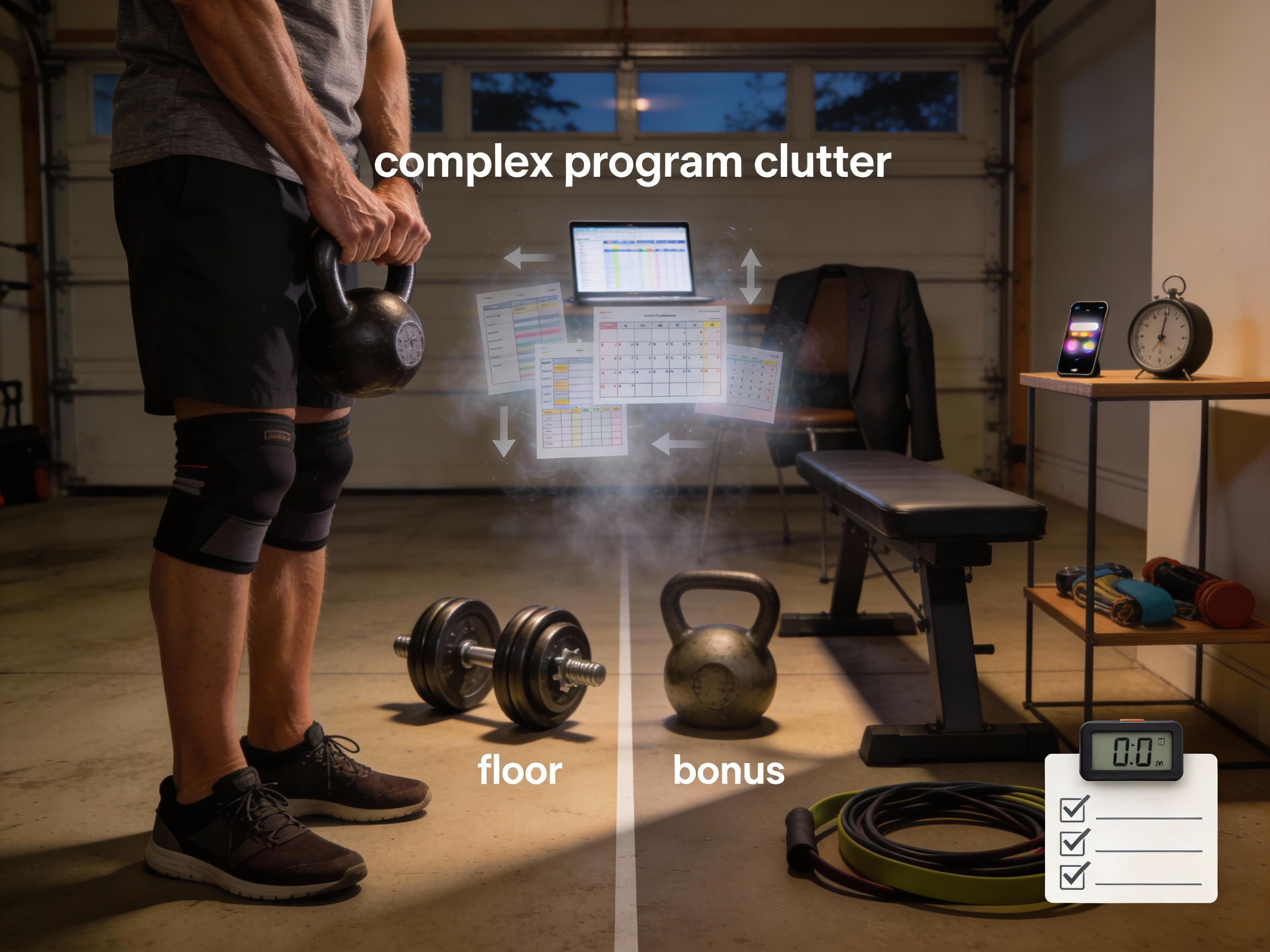
Here's something that will sound familiar.
You can manage a team of twelve people. You navigate complex budgets without flinching. You execute projects that would make most people's heads spin.
But hand you a strength training program? Six weeks later, you're starting over. Again.
The fitness industry has a ready explanation: you lack motivation. You're not committed enough. You just need to want it more.
Wrong.
What you're experiencing isn't a motivation collapse. It's an execution collapse caused by structural design failure. And once you see the real problem, everything changes.
The Real Problem: Programs Built for Lives That Don't Exist
Think about what most strength programs assume.
They assume you have spare time. Spare energy. A clean recovery runway. Stable sleep. Predictable stress levels.
How many weeks out of the year do you actually have all of that?
If you're over 40, the answer is probably "almost never." You're carrying work demands that shift daily. Family obligations that don't negotiate. Sleep debt that compounds. Stress that spikes without warning.
The program you "should" be able to follow? It only works during your best weeks.
And best weeks are rare.
Ever caught yourself thinking, "I know what to do, I just don't do it"? That's not a confession of personal failure. That's a diagnosis. Your plan doesn't match your actual constraints.
The structural breakdown happens in three predictable ways.
1. Too Many Moving Pieces
Every session becomes a negotiation.
What exercises today? Which weights? How should I warm up? What's my progression scheme? Do I have time for the full workout or should I modify it?
You're spending willpower and attention before you even touch a weight.
Here's the thing: high performers have plenty of drive. But you spent your daily decision budget at work. By the time you get to the gym, your cognitive tank is running on fumes.
The program doesn't fail because you're weak. It fails because it's not engineered to be simple and repeatable under cognitive load.
2. Recovery Assumptions That Don't Match Reality
Let's talk about what your body is actually dealing with.
Poor sleep. Elevated stress. Persistent stiffness. Joint discomfort. Energy that varies wildly from day to day.
Research shows that older muscles may require longer recovery periods, though the magnitude varies by individual.
But most programs ignore this completely. They're written as if you're 25 with perfect sleep and zero life stress.
So what happens? You constantly feel behind. Soreness accumulates. You miss sessions. You restart.
The cycle repeats.
You're not lazy. You're overloaded. And the program never accounted for that.
3. Over-Prescribed Intensity, Under-Built Systems
Here's what most programs give you: progressive overload charts. Perfect weekly frequency. Ideal training splits.
Beautiful on paper. Impossible in practice.
They're performance templates, not behavior systems designed to survive real life.
A solid process works differently. It starts by identifying what's doable immediately and consistently. Then it progressively builds capacity from there.
If your consistency drops below 80%, the solution isn't trying harder. It's making the task easier to execute.
Most programs get this exactly backward.
Why the Industry Keeps Misdiagnosing This
Motivation makes for an easy story. A convenient product pitch.
Think about it. If failure is your fault (you're lazy, undisciplined, not hungry enough), then the program stays "perfect." The solution is always the same: more intensity, more tracking, more guilt, more accountability theater.
But this narrative ignores an uncomfortable truth.
Most self-directed plans fail because the plan wasn't designed for your life.
High performers aren't failing because they don't want results. They're failing because the program requires a version of
their week they rarely get to live.
Once you see this, you can't unsee it.
Designing for Worst-Case Maintainability
So what's the alternative?
When I design a strength protocol for adults over 40, I stop asking "what's optimal on a perfect week?"
Instead, I ask: "What's the smallest version that still produces a training effect and can be executed when sleep is terrible, work is heavy, and joints are cranky?"
That single shift changes everything about program structure.
Template-Based, Not Decision-Based
Same days. Same warm-up. Same main lifts. Same accessory slots.
Every time.
Sounds boring? That's the point.
Variety becomes the enemy of compliance when you're operating under cognitive load. The goal is fewer choices and more autopilot.
The action has to be so clear, so automatic, that you can execute it under pressure without thinking.
Floor and Bonus Structure
This is where it gets interesting.
Every session has two versions:
Floor version: 10-20 minutes, minimum effective dose
Bonus version: 30-45 minutes, full protocol
Here's the key: hitting the floor counts as complete success.
Not a consolation prize. Not "better than nothing." Complete success.
This single rule prevents the all-or-nothing spiral that kills consistency. Your routine survives bad weeks instead of requiring hero weeks.
And that changes everything.
Autoregulation by Default
Forget fixed percentages. Forget aggressive progression schemes.
The plan uses effort caps and rep ranges with "leave 2-3 reps in the tank" as the standard operating procedure.
Why? Because recovery is the variable that keeps changing in this population.
Intensity has to flex without breaking the plan. Otherwise, one bad night's sleep derails your entire week.
The Actual 2-3 Day Structure
Let's get concrete. What does this actually look like?
For a 2-day plan, I program two full-body sessions (A/B) with one main lower-body movement, one main upper-body movement, and a small joint-friendly "resilience" block each day.
For a 3-day plan, the structure stays full-body with slightly lower per-session volume and more frequent movement exposure.
Here's the session template that makes it work:
Session Template
1. Standardized warm-up (5 minutes, always identical)
Three movements. That's it.
One for hips, one for thoracic spine and shoulders, one easy pattern rehearsal for the first lift.
This reduces stiffness and protects joints without turning warm-up into a 20-minute barrier that prevents you from starting.
2. Main lift 1 (10-15 minutes)
One lower-body pattern: squat variant, hinge variant, or split squat.
Joint-friendly substitutions are planned in advance. Goblet squat instead of back squat. Trap-bar deadlift or RDL instead of conventional deadlift. Split squat instead of heavy bilateral work if knees or hips are cranky.
Notice what this does: you don't skip the day because the perfect lift doesn't feel perfect.
3. Main lift 2 (10-15 minutes)
One upper-body pattern: press or row/pull.
Pre-approved substitutions include incline dumbbell press instead of barbell, neutral grip row instead of pull-ups, landmine press if shoulders hate overhead work.
Same principle. Maximum flexibility within a clear structure.
4. Resilience block (5-10 minutes)
Two short accessories that build durability.
Carries, trunk work, glute medius, hamstrings, upper back, calves, or light sled work if available.
These are tissues and positions that make life and training feel better. Think of them as buying you long-term survivability.
The Floor vs Bonus Rule in Action
Floor session: Warm-up + main lift 1 + main lift 2 (2 work sets each). Done in roughly 20 minutes.
Bonus session: Add 1-2 extra sets on main lifts plus the resilience block. Done in 35-45 minutes.
Here's what this means for you: you never face a week where the only options are "do it all" or "do nothing."
Bad week? Hit the floor. Good week? Go for the bonus.
Either way, you win.
Progression That Doesn't Require Perfect Recovery
Let's talk about getting stronger.
I keep progression deliberately boring and slow.
Not because it's less effective. Because it's more sustainable.
Rep-range progression: Choose a range like 6-10 reps. Use the same weight until you can hit the top of the range on all sets with good form and moderate effort. Then add a small amount of weight and drop back toward the lower end.
Simple. Predictable. No guesswork.
Effort cap: Most sets at "could do 2-3 more reps." If sleep was bad or stress is high, you keep the same weight and do fewer reps, or you execute the floor version and move on.
No heroics required.
Hard sets are rationed: At most one "push" set per session, optional and never mandatory. This avoids the recovery tax that triggers missed sessions.
The research backs this up. Studies demonstrate that one session per week with four or more exercises can improve muscle strength in previously untrained individuals. Even more striking: strength and muscle size can be maintained for up to 32 weeks with as little as one session per week and one set per exercise, as long as exercise intensity is maintained.
Translation? The minimum effective dose is real.
Scheduling Decisions That Assume Chaos
Let's talk about when you actually train.
Two anchor days, one flex day if doing three days per week. Example: Tuesday and Thursday anchors, Saturday flex.
If the flex day dies? You still completed the anchors. Still a win.
Never schedule three consecutive training days. Adults over 40 dealing with poor sleep and stress make that a predictable breakdown point.
Every session can be done with minimal equipment. I write the travel version beside the gym version so disruptions don't force complete redesign.
The schedule has to be chaos-proof from day one.
Building In Contingencies Without Creating Decision Trees
Here's where most programs completely fall apart.
Your knee is cranky on squat day. Or your shoulder hates overhead pressing. What do you do?
Most programs say either "push through it" or "figure it out yourself." Both options are terrible.
The solution? You pre-plan contingencies by standardizing them into a small set of "if this, then that" rules that operate at the pattern level, not the exercise level.
The mistake is trying to anticipate every scenario with a sprawling decision tree. The goal is the opposite: a tiny, repeatable substitution system that reduces thinking.
Anchor to Movement Patterns
The program is written as "today is squat pattern + row" rather than "today is back squat + pull-ups."
See the difference? When a joint complains, you're not changing the workout. You're selecting the approved version of the same pattern.
This keeps the structure intact while giving you the flexibility you actually need.
Fixed Menu for Each Pattern
Three options only. That's it.
A primary, a backup, and an emergency. Same order every time.
Squat pattern example:
Primary: goblet squat or safety bar squat
Backup: box squat or split squat
Emergency: leg press, step-up, or isometric hold
Overhead press pattern example:
Primary: landmine press or incline dumbbell press
Backup: neutral-grip dumbbell press
Emergency: cable press, push-up variations, or pain-free partial range
Simple Rule Set
Pain scale filter:
0-2/10 discomfort: proceed as planned
3-4/10: use backup option and reduce load
5+/10 or sharp/unstable pain: use emergency option or switch to different pattern
No diagnosis. No overthinking. Just a threshold.
Keep the session skeleton unchanged: Warm-up stays the same. The two main slots stay the same. Only the lift choice within the slot changes.
This prevents the "well now what do I do?" spiral.
Same progression rules across all options: Rep range and effort cap don't change because the exercise changed. This keeps the program coherent and prevents people from treating regressions like failure workouts.
One Lever at a Time
When something hurts, you don't change five variables. You change one in a set order:
1. Range of motion
2. Grip, stance, or implement
3. Tempo (slower, more controlled)
4. Load
This is how you avoid improvisation. It's a pre-decided troubleshooting sequence.
Substitutions Written Into the Program
Here's what makes this work in real life.
On the workout sheet, the slot reads:
Squat pattern (choose first option that feels good today):
A) Goblet squat
B) Box squat
C) Split squat
That's not a decision tree. That's a ranked list.
You can reduce cognitive load even further by giving default triggers:
Knee cranky trigger: choose option B automatically
Shoulder cranky trigger: choose option A automatically
You're not deciding. You're running a rule.
Zero thinking required.
The Metric That Actually Matters
Forget weight on the bar for a moment.
The main score is consistency: did you complete 2-3 sessions this week in any form?
That's it. That's the metric.
If consistency drops under 80%, the next move is not adding complexity. It's making the task easier to execute and stripping friction. You adjust the plan based on what the data say is actually happening.
Before locking in any plan, I run a confidence check. If you're not at least 9/10 confident you can hit the floor version on a bad week, the plan is still too big.
Then we shrink it until it's nearly fail-proof.
Studies show that adherence measures typically range from 65-86% program completion and 58-77% of available sessions attended. The most reliable predictors of adherence are higher self-efficacy and good self-rated mental health, not age, sex, or comorbidity status.
What this means for you: if you believe you can do it and your mental health is stable, you're more likely to stick with it. The program's job is to make that belief justified.
Why This Works When Everything Else Fails
Let's bring this all together.
Best-case programs chase performance metrics. Disruption-resistant programs protect identity and consistency.
They make training so simple, so flexible, and so pre-decided that even a rough week can't break the chain.
You're not building a program that works when everything goes right. You're building a system that survives when everything goes wrong.
That distinction matters more than anything else.
Here's what's at stake.
Starting at age 30, your body naturally loses 3-5% of muscle mass per decade. Research indicates that muscle strength declines between 16.6% and 40.9% from under-40 to over-40 age groups. Adults who don't do regular strength training can expect to lose 4-6 pounds of muscle per decade.
So the question isn't whether you need to train.
The question is whether your training program is designed for the life you actually live.
Most programs fail because they optimize for ideal conditions while you operate under volatile ones.
They assume stability you don't possess. They require a version of your week that rarely materializes.
A 2-3 day minimum effective dose works because it's built for disruption from the ground up:
Template-based structure eliminates decision fatigue. Floor and bonus options prevent all-or-nothing spirals. Pre-planned substitutions handle joint pain without improvisation. Effort caps and slow progression accommodate fluctuating recovery.
The sophistication isn't in the complexity.
It's in the survivability.
You don't need a perfect program. You need a program that can't be broken by normal life.
That's what actually works after 40.