
Why Your Health Plan Keeps Breaking (And How to Build One That Survives Your Actual Life)
I had a check-in call that should've been a win.
She had everything: home gym, flexible schedule, a training plan I was proud of. We built it for her best week. Four workouts, tracked nutrition, clean meals, sleep targets.
Then life hit.
Not a crisis. Normal chaos: work project exploded, kid got sick, sleep dipped. Two nights turned into takeout and "I'll get back on track Monday."
What stood out wasn't that she fell off.
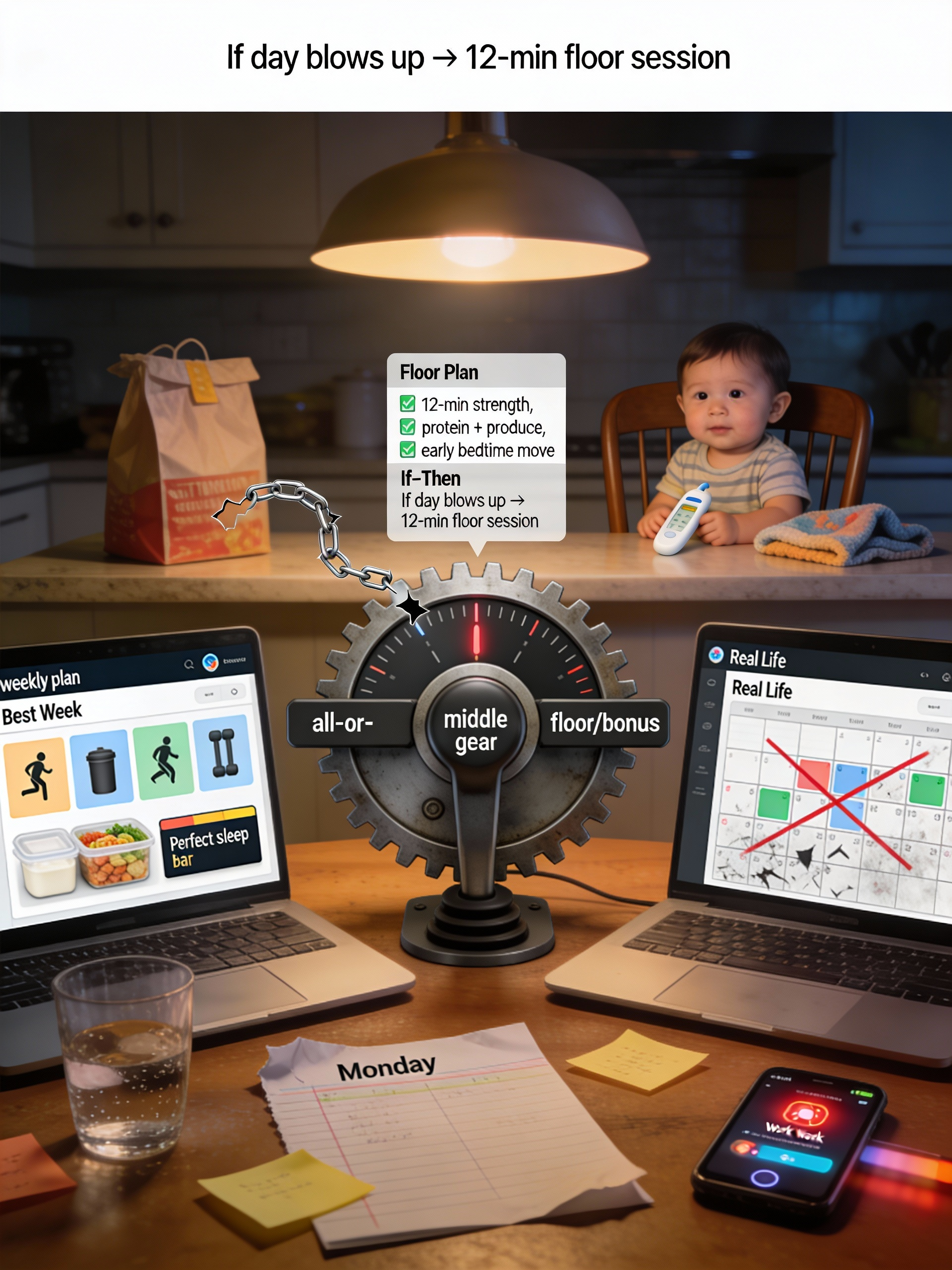
It was what happened next: the plan had no middle gear.
It was either "do the full plan" or "do nothing." So when she missed one workout, she missed three. When she stopped tracking, she stopped paying attention completely.
And when we talked, the conversation wasn't about problem-solving. It was shame.
That's when I realized the standard approach was structurally broken. Most programs are built for an imaginary person who sleeps eight hours, has predictable workdays, no travel, no sick kids, no unexpected deadlines, and zero emotional bandwidth issues.
Then we act surprised when humans can't follow it.
The Real Problem: Your Plan Assumes Stability You Don't Have
After that call, I started paying attention across check-ins.
The pattern was consistent:
- People weren't failing because they were lazy
- They were failing because the plan required ideal conditions
- And the second conditions were imperfect, the system collapsed
Here's what the research shows: we make up to 35,000 decisions daily, and constant workplace choices drain glucose in your prefrontal cortex.
The area responsible for clear decision-making.
As the day progresses, engagement in effortful tasks leads to fatigue. We become less willing to exert cognitive effort.
By the time you're deciding about dinner or whether to work out, you're not making the choice with your best brain.
You're making it with the brain that survived 10 hours of problem-solving.
Here's the kicker: research on the intention-action gap reveals something useful. Even a medium-to-large change in commitment only leads to a small-to-medium change in behavior.
Forming strong goal intentions doesn't guarantee goal attainment.
Wanting it more doesn't fix a broken design.
What Changed: Building for Chaos Instead of Perfection
I changed my design philosophy completely.
Instead of asking "What's the optimal plan?" I started asking: "What's the plan you can keep when your week is on fire?"
That's where the worst-week framework came from.
If your plan only works on your best week, you don't have a plan. You have a fantasy.
Here's how it works in practice.
Step 1: Start with a worst-week audit
I ask questions like this.
- "What does your worst normal week look like?" (not vacation, real chaos)
- "What are the top three things that blow up your routine?"
- "When things go sideways, what do you still have?" (10 minutes? a hotel gym? a driveway? nothing?)
I'm looking for constraints, not goals.
Step 2: Pick the minimum viable inputs
I lock in three anchors:
- Movement (strength-focused, not "sweat")
- Nutrition (one lever, not a full makeover)
- Recovery (sleep or stress downshift, something that protects bandwidth)
Step 3: Cut the fragile stuff first
The first things to go are anything that collapses under pressure:
- Long workouts
- Complicated exercise menus
- Perfect weekly schedules
- Detailed macro targets
- "Track everything" plans
If it requires high motivation or extra time, it's not worst-week safe.
Step 4: Create non-negotiables with built-in flexibility
This is the "middle gear" part.
Instead of "train four times per week," it becomes:
- Two strength sessions is the floor
- 10-15 minute minimum session counts
- One travel/hotel option
- One no-equipment option
- One "I'm cooked" option (mobility + walk + early bedtime)
Non-negotiable doesn't mean hard. It means clear.
Step 5: Build if-then rules before the week starts
This is where implementation intentions become useful. Studies show they automate action initiation. Making it immediate, efficient, and not requiring conscious intent.
Here are the rules I use with clients.
IF my day blows up and I miss my workout, THEN I do the 12-minute floor session.
Two moves, timer on. Example: goblet squat + push-ups for 12 minutes. The win is keeping the chain, not chasing the perfect session.
IF I'm about to order or eat out and I'm tired or rushed, THEN I use my default order.
Protein + produce + a carb. Chipotle: double chicken, fajita vegetables, salsa, rice. No scanning the menu like it's a test.
IF I walk into the kitchen and I'm snacky, THEN I drink water and eat protein first.
Not because water is magic. It interrupts the autopilot. Then the rule is: protein first, then decide.
IF I slept less than six hours (or feel cooked), THEN today is a "protect the system" day.
Training becomes minimum effective. Caffeine has a cutoff. One "early bedtime move" happens.
IF I miss one day, THEN I do not make up for it. I return to baseline at the next opportunity.
No punishment workouts. No starvation day. Just: next planned session, next normal meal. This is what prevents the spiral.
The whole point: when chaos hits, you shouldn't have to think. You execute a rule and stay in the game.
Why This Works When Motivation Doesn't
I used to think my job was to motivate people. Push them, hold them accountable.
Then I had a client tell me: "I dread our check-ins. I feel like I'm coming to report my failures."
That sentence changed everything.
Because when I tried to manufacture motivation, I was accidentally manufacturing shame. And shame doesn't create consistency. It creates hiding. It creates avoidance. It creates the all-or-nothing spiral.
So now I treat coaching like design and problem-solving, not pep talks.
I remove the moral weight. We separate behavior from identity. You didn't "fail." Your plan didn't match your week.
I look for the constraint. Not "why didn't you do it?" More like: "What specifically made this hard? Time, stress, sleep, decision fatigue, environment?"
I build the middle gear. Floor/bonus plan. If-then rules. Defaults. So you have an automatic response when life hits instead of starting over.
I focus on small wins that rebuild trust. We pick one or two actions you can hit on a bad week. Consistency isn't about intensity. It's about reliability.
My job isn't to hype you up. My job is to make the plan so practical, and so resilient, you don't need hype to execute it.
The Law Firm Partner Who Hit Eight Weeks Straight
I had a client. Law firm partner, calendar was chaos, who hadn't exercised consistently in three years.
The story was always the same: "I'm either all-in for two weeks... or nothing for two months."
The first version we built was still too "fitness-coded." 45-60 minute sessions, too many exercise options, a weekly schedule assuming open blocks.
The unspoken rule was: "If I can't do it right, I'll do it later."
So when deadlines hit, the plan didn't bend. It broke. He didn't "miss a workout." He lost the week.
The version that finally stuck was built around one principle: short, repeatable, and decision-free.
We made it calendar-first, not motivation-first. Instead of "three times per week whenever," we picked three repeatable windows: Tuesday/Thursday/Saturday. Each window had a minimum session fitting inside 20 minutes door-to-door.
No "find time." It was booked like a meeting.
We removed the exercise menu. He had two workouts that repeated A/B style. Same warm-up. Same first two lifts. Same flow.
Because the friction wasn't the workout. It was the decisions.
The 20 minutes was real. Not "20 minutes plus setup plus scrolling."
Minute 0-3: On-ramp
1-2 quick mobility moves, one ramp set for the first lift
Minute 3-18: The meat
Two movements, paired: a lower body strength pattern and an upper body push/pull. Usually 3-4 quality sets total.
Minute 18-20: Finisher or done
Optional carry, bike, incline walk, or core. If time was tight: session still counted without it.
We built the if-then rules before the week started:
- Miss Tuesday → do it Wednesday morning
- Miss Thursday → do it Friday
- Travel week → hotel version only
- Long day / low sleep → minimum session only
He never had to ask "What should I do now?" He executed the default.
We changed the success metric. Success wasn't "hard workout." Success was keeping the chain.
I told him: "I don't care if it's your best session. I care that you showed up enough to stay in identity."
That's why he hit eight straight weeks.
Not because he suddenly became more disciplined. He already was. We stopped making the plan depend on perfect weeks.
What Actually Changes When You Build This Way
When you design for your worst week instead of your best week, three things happen.
1. You stop restarting
The plan has a floor. When life explodes, you don't abandon ship. You drop to the minimum version and keep moving. That continuity is what builds momentum.
2. You stop negotiating
If-then rules eliminate the 35,000 daily decisions draining your prefrontal cortex. You're not debating whether to work out. You're executing the rule for Tuesday at 7am.
3. You stop spiraling
One imperfect day doesn't become three. Because the plan expects imperfection and has a response ready. You learn the skill that matters most: continuing without drama.
Consistency isn't built by perfect weeks. It's built by clean recoveries.
How to Build Your Own Worst-Week Plan
Here's where to start.
Audit your constraints
Write down what your worst normal week looks like. Not vacation, just real chaos.
What blows up your routine? What do you still have access to when things fall apart?
Pick your floor
What's the smallest version you will do that still counts? Two 15-minute strength sessions? One real meal? A 10-minute shutdown routine before bed?
Make it so easy that doing it on a terrible day feels possible.
Write your if-then rules
IF [specific trigger], THEN [specific action].
IF I miss Monday, THEN I do it Tuesday morning.
IF I'm traveling, THEN I do the hotel version.
IF I'm exhausted, THEN I do the 10-minute floor session.
Write them down. Don't improvise when you're tired.
Remove decisions
Same two workouts. Same default meal. Same wake time window. Same shutdown cue.
Boring wins. Variety loses.
Redefine the win
Success isn't the perfect week. Success is: you kept the chain. You hit the floor. You continued without drama.
That's the skill. That's what makes you unbreakable.
The Real Shift
I used to design programs to impress me on paper.
Now I design them to hold up when life does what it always does.
If your plan only works when conditions are perfect, you don't have a system. You have a performance. One that collapses the moment reality shows up.
Build for chaos. Build for your worst week. Build the middle gear.
That's how you stop restarting and start becoming consistent.