
Why Your "Perfect" Setup Is Making You Less Consistent
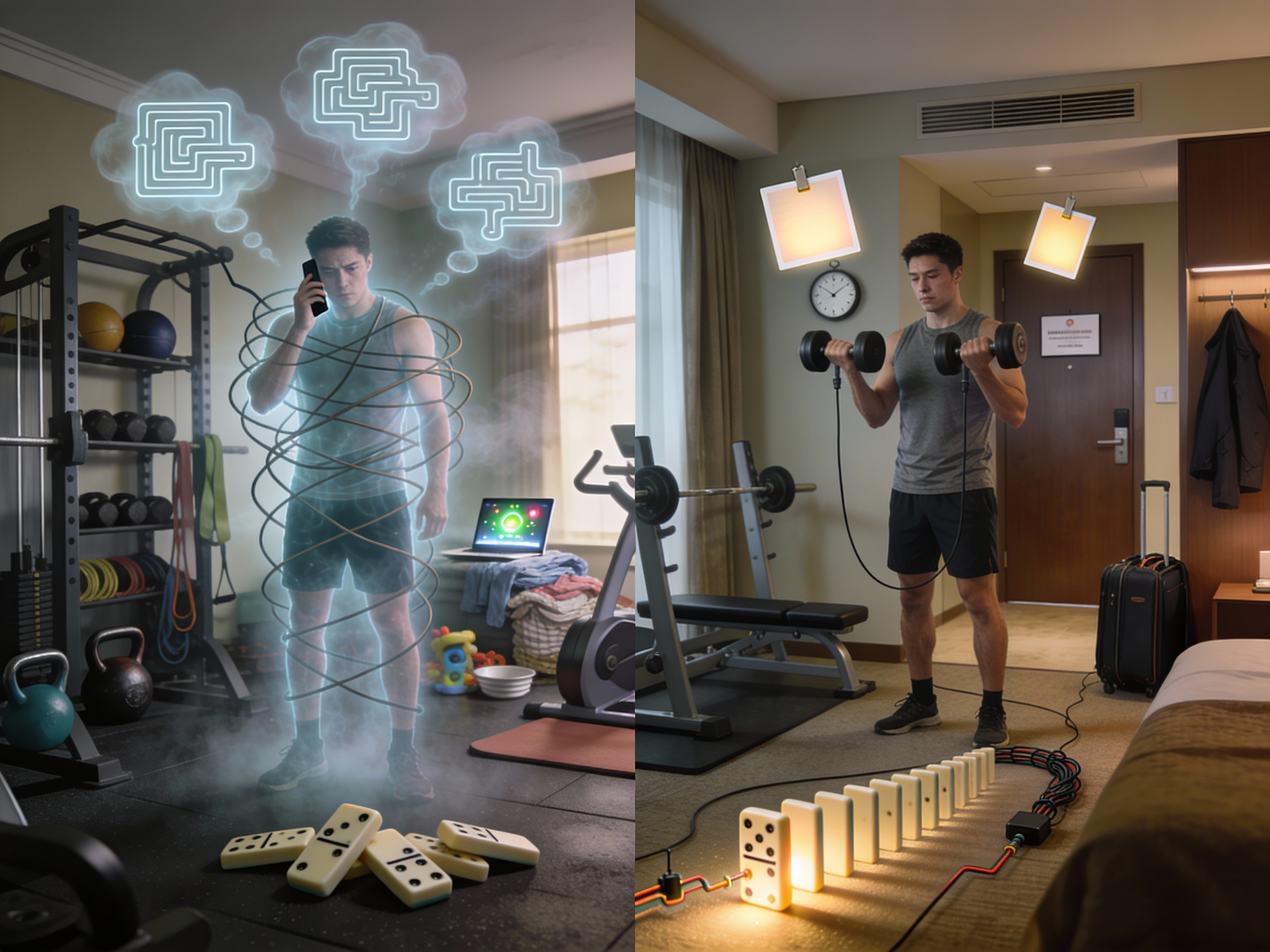
I noticed something odd in my check-ins last month.
The client who travels three times a month hit nine out of ten planned sessions.
The one with a home gym, flexible schedule, and every piece of equipment you'd want? Missed week after week.
The people with the most options were the least consistent. The people with the most constraints were executing.
This flipped everything I thought I knew about program design.
The Home Setup Problem
Here's what I started seeing:
When you have unlimited options, "anytime" becomes negotiation. Negotiation becomes delay. Delay becomes "not today."
The client with the home gym wasn't less motivated. She was drowning in options.
Every workout became a decision:
- What time should I train?
- Which program should I follow?
- Should I do upper or lower today?
- Maybe I should wait until I have more energy.
- I'll do it after this one more thing.
Meanwhile, the home environment comes with friction travel doesn't have:
- Work spills over into evening hours
- Kids need something
- One more email appears
- Chores pile up
- Comfort whispers "you'll do it later"
The traveler didn't have later. He had now or never.
What Constraints Force
The traveling client wasn't operating with more discipline. He was operating under different rules.
Limited time windows meant he couldn't negotiate. A cramped hotel gym meant he couldn't overthink exercise selection. Unpredictable schedules meant he needed defaults.
So his system looked like this:
- "What's the smallest effective thing I do right now?"
- "What's my default order when eating out?"
- "Where's my 20-minute window today?"
No perfect routine. No ideal conditions. Clear rules working anywhere.
Constraints weren't a disadvantage. They were a design advantage.
They force clarity. They eliminate the negotiation phase. They turn execution automatic.
The Real Enemy Isn't Lack of Equipment
After I saw this, I started redesigning home-based plans like travel plans.
Instead of "train whenever you have time," I asked clients to pick specific windows. Instead of offering variety, I built a smaller menu. Instead of "do your best," I defined minimum sessions.
The "perfect setup" clients got more consistent.
The real enemy wasn't lack of equipment. It was lack of structure.
Your home gym doesn't make you consistent. Your decision-making architecture does.
How to Build Constraint Into Comfort
You don't need to start traveling to get this benefit. You need to design like you're traveling when you're home.
Here's what this looks like in practice:
1. Pick specific windows, not "whenever"
Instead of "I'll train sometime today," book it like a meeting. Tuesday at 6am. Thursday at 5:30pm. Saturday at 9am.
The window creates the constraint. The constraint eliminates negotiation.
2. Build a smaller menu
Two workouts repeating A/B style. Same warm-up. Same first two lifts. Same flow.
You're not removing variety out of boredom. You're removing decisions. Decisions create friction.
3. Define your minimum session
What's the version counting when your day explodes? For most people, 10-15 minutes. Two movements. Quality over volume.
The minimum session keeps the chain intact. What matters when life gets chaotic.
4. Use defaults for food
The traveler doesn't scan the entire menu every time. He has a default order at three places he knows he'll end up.
You do the same thing at home. One consistent breakfast. One default dinner structure. One "I'm tired and don't want to think" meal.
5. Write if-then rules before the week starts
If I miss Tuesday, I do it Wednesday morning. If my day blows up, I do the 12-minute floor session. If I'm traveling, I use the hotel version.
You never have to ask "what should I do now?" You execute the default.
Comfort Builds Fragility
People with stable environments built plans requiring stable environments. Then the first disruption collapsed everything.
The traveler couldn't build this way. His environment was always unstable. So his system had to survive disruption by design.
This is the advantage you're looking for.
You want a system working when conditions are bad. Not a system only working when conditions are perfect.
Perfect conditions don't show up on schedule. Chaos does.
What This Means for Your Plan
If your current setup requires ideal conditions to execute, you don't have a plan.
The fix isn't more equipment. Not more time. Not more motivation.
The fix is designing like you have constraints even when you don't.
Pick your windows. Shrink your menu. Define your minimum. Build your defaults. Write your if-then rules.
Make the plan so clear execution becomes automatic.
What the traveler figured out by accident. What you build on purpose.
Constraints force creativity. Comfort builds fragility.
The question isn't whether you have the perfect setup. The question is whether your setup forces you to be clear.