Your Fitness Tracker Is Making You Anxious (And Worse at Fitness)
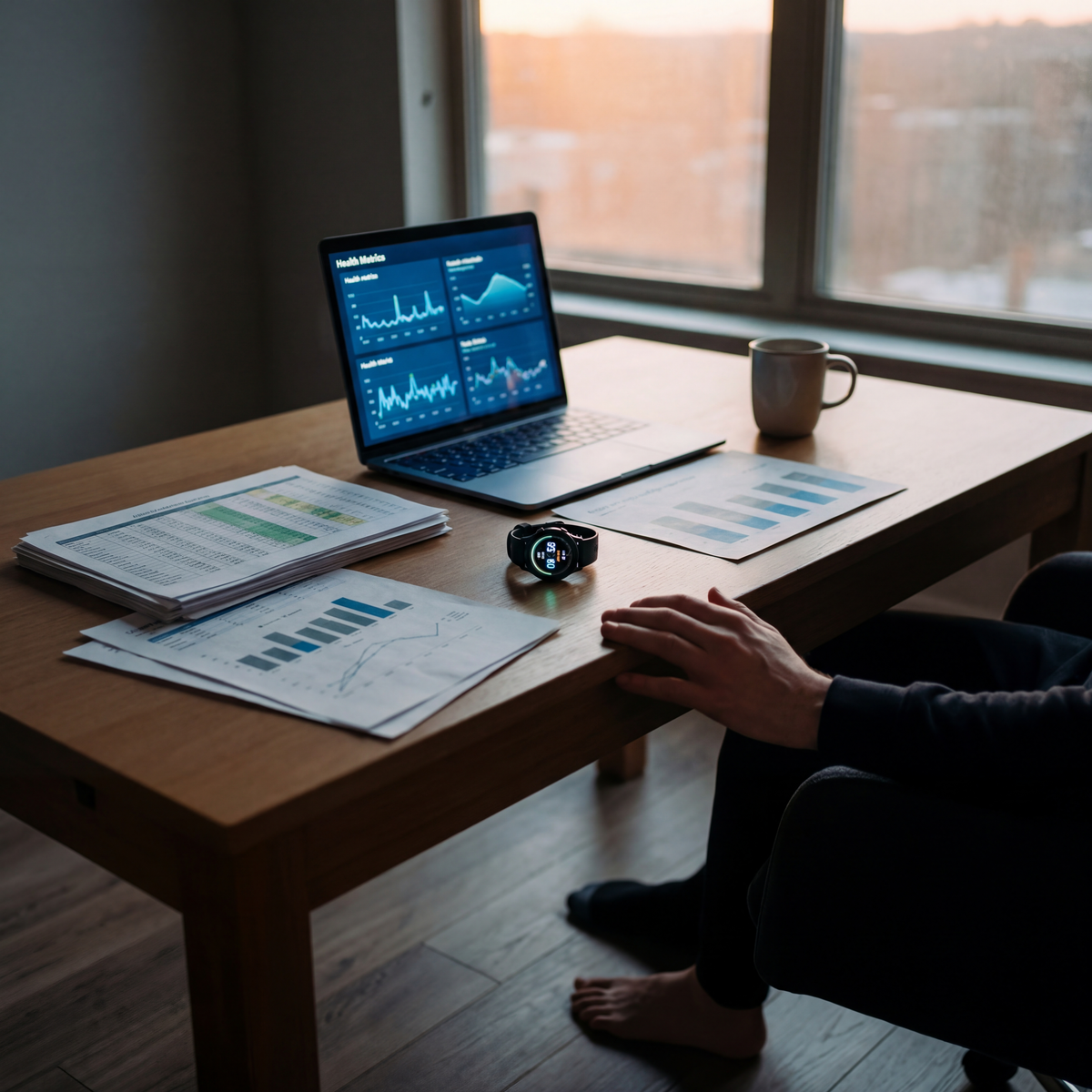
I had a client who tracked everything. Calories, macros, steps, sleep quality, heart rate variability, workout intensity. His spreadsheets were beautiful. His compliance was near perfect.
His results were getting worse.
Weight loss had stalled. Energy was dropping. Sleep scores kept declining. Every workout felt heavier than the last.
The data wasn't helping him. It was judging him.
Every number became a verdict. A low step count meant he'd "failed the day." Slightly higher calorie intake triggered compensation the next day. Poor sleep data made him anxious before his day even started.
His nervous system never got a break.
The Measurement Trap High Performers Fall Into
High performers bring their professional toolkit to fitness. They set KPIs for their bodies. They track metrics. They optimize for outcomes.
It makes sense. The approach works everywhere else in their lives.
But bodies don't respond to spreadsheet logic.
The more my client tracked, the more he tried to control outcomes already being suppressed by stress and fatigue. The data amplified his all-or-nothing thinking. It eroded his trust in basic signals like hunger, fatigue, and readiness.
The tools meant to create clarity were reinforcing the dysregulation blocking his progress.
Nearly 30% of people who obsessively monitor health metrics develop anxiety around those numbers. Almost 60% of health tracker users report increased anxiety and stress because of constant monitoring.
The irony here is striking. When you stress about sleep scores, your body activates its stress response... which keeps you awake longer.
When Data Becomes a Courtroom Instead of a Compass
The problem isn't measurement itself. The problem is what measurement does to your relationship with your body.
Data should inform decisions. Instead, for many high performers, it becomes a constant performance review.
You wake up and immediately check how you slept. The number tells you whether you're allowed to feel rested. You ignore how your body feels in favor of what the tracker reports.
Research from the University of Copenhagen found many people rely on fitness tracker data as if it were medical advice, often sparking unnecessary fear and anxiety.
The morning ritual of checking sleep scores creates stress about rest quality, regardless of how refreshed you feel.
This is what I saw with my client. His data wasn't guiding behavior. It was creating constant threat and self-surveillance.
The Perfectionist Profile
The personality type most vulnerable to tracking-induced anxiety is telling.
Perfectionists and people with obsessive-compulsive traits become rigid about meeting tracking goals. They develop compulsive checking patterns. They experience increased distress when numbers don't align with expectations.
These are often the same traits making someone successful in their career. Applied to fitness... they become a liability.
When my client's metrics failed to meet expectations, the tracker made him anxious. He became increasingly preoccupied with symptoms. He developed a heightened state of vigilance about his health numbers.
One in five Americans now wear these devices. We're running an unprecedented experiment in constant self-surveillance.
What Changed When We Went Dark
I didn't remove structure from my client's program. I changed what data was allowed to matter.
We stripped tracking down to two behavioral indicators only:
"Did I complete the agreed minimum?"
"How did my energy feel by mid-afternoon?"
Everything else went dark for six weeks.
No calorie counting. No macro tracking. No sleep scores. No step goals. No heart rate variability analysis.
Just two simple questions requiring noticing, not measuring.
The shift happened faster than either of us expected.
Within two weeks, he mentioned sleeping better. By week four, his appetite had stabilized. His workouts felt strong again instead of punishing. By week six, his body composition had improved more than it had in the previous six months of perfect tracking.
The data hadn't been helping. It had been the primary source of stress.
The Hidden Cost of Optimization
The broader "quantified self" movement reveals troubling patterns beyond individual anxiety.
The anxiety shows up every time you encounter "poor" data. Activities not easily quantifiable get discouraged. Tracking technologies create an ordering of people and experiences... discouraging moments which you can't measure.
Critics point out the quantified self movement provides predetermined ideals of health and wellbeing. Rather than increasing personal skills for self-knowledge, it distances you from yourself by offering an inherently normative and reductionist framework.
You stop asking "How do I feel?" and start asking "What does my data say I should feel?"
When Health Tracking Becomes Orthorexia
For high achievers pursuing optimal health, there's a risk we don't discuss enough.
Orthorexia nervosa is an obsession with healthy eating with associated restrictive behaviors. It leads to malnourishment, loss of relationships, and poor quality of life.
Research has found significant positive correlations between orthorexia and both narcissism and perfectionism. Athletes and top performers struggle with this pattern because "healthy" eating and excessive exercise are expected to compete at optimum performance.
The line between optimization and pathology gets blurry when your identity depends on perfect execution.
The Workplace Dimension
Corporate wellness programs add another layer to this problem.
When companies measure and intervene in burnout and workplace stress through self-tracking, they place the burden of stress management directly on the worker.
The focus stays on individual behavior instead of on managers who have more power to change underlying structural issues.
Your tracker tells you you're not recovering well. It doesn't tell you your workload is unsustainable or your schedule is unrealistic.
The data makes it feel like a personal failing when often... a systems problem causes the issue.
What Data Can't Capture
Taking a long walk with friends seems inefficient compared to jogging alone. But if it leads to a more sustainable habit preventing burnout, then it's more effective as a long-term strategy.
Data is most useful when it empowers you to make informed decisions based on your holistic view of your own wellbeing.
Intuition matters. Subjective experiences matter. The simple joy of movement in nature matters.
These things don't show up in your tracking app. But they determine whether your fitness practice survives the next five years.
The Questions Data Can't Answer
Your tracker tells you how many steps you took. It can't tell you whether the walk cleared your head or felt like another obligation.
It measures your heart rate during a workout. It can't measure whether you felt strong or whether you were grinding through fatigue.
It scores your sleep. It can't tell you whether you woke up feeling rested or whether you're carrying stress numbers can't capture.
The most important signals are often the ones resisting quantification.
How I Use Data Now
I'm not anti-measurement. I'm anti-measurement-as-identity.
When I work with clients now, data serves a specific, limited purpose. It answers one question: Is the system holding?
Not "Am I perfect?" Not "Am I optimized?" Just "Is this doable?"
We track the smallest number of variables providing useful feedback. Usually two or three behavioral markers, at most.
If tracking increases anxiety or self-judgment, we remove the tracking immediately.
The goal isn't to eliminate information. The goal is to eliminate information creating more problems than it solves.
The Two-Question Framework
For most high performers, these two questions provide more useful guidance than any tracker:
1. Did I do the thing I said I'd do?
This measures behavioral consistency... which is the only variable predicting long-term outcomes.
2. Do I have more energy or less energy than last week?
This measures whether your system is recovering or depleting, which determines whether your current approach is sustainable.
Everything else is noise until these two answers are consistently positive.
When Tracking Helps
There are situations where measurement serves you instead of stressing you.
Tracking helps when you're genuinely uncertain about a pattern. If you can't tell whether your sleep is poor or whether you're catastrophizing... a few weeks of data provides clarity.
It helps when you're testing a specific variable. If you're trying to understand how caffeine timing affects your sleep, tracking the relationship makes sense.
It helps when the act of tracking doesn't change your emotional state. If you look at data neutrally, as information rather than judgment, measurement guides useful adjustments.
But for most high performers, tracking doesn't meet those conditions. It creates pressure, not clarity.
The Simplicity Solution
My client eventually added some tracking back in. But the relationship changed.
He checks his data once a week now, not every morning. He looks for trends over time, not daily verdicts. He treats numbers as one input among many, not as the primary authority on how he should feel.
Most importantly, he's learned to notice when measurement starts creating stress instead of reducing it. When this happens, he goes dark again until the relationship resets.
His results are better than they've ever been. Not because he's tracking less... but because he's stressing less.
The body responds to support, not surveillance.
What to Do If You're Stuck in the Data Trap
If you recognize yourself in this pattern, here's what works:
Go dark for 4-6 weeks. Not forever. Just long enough to reset your relationship with your body's signals.
Replace metrics with two simple questions. Did you do what you planned? How's your energy trending?
Notice what changes when you're not being constantly evaluated. Does sleep improve? Does appetite stabilize? Do workouts feel less like tests?
Add measurement back slowly, and only if it serves you. If a metric makes you anxious, it isn't helping.
Prioritize how you feel over what the data says. Your body's signals are valid even when they don't match the numbers.
The goal isn't to become anti-data. The goal is to stop letting data override your direct experience of your own body.
The Real Optimization
High performers optimize everything. It's what makes them successful.
But the body doesn't work like a business. You can't KPI your way to health.
Sometimes the most sophisticated thing you do is trust you know when you're tired, when you're hungry, and when you need rest.
Sometimes the data is the problem.